

Just as we are all teachers of literacy, as biologists, we clearly have a role to play in the integration of sex, sexual health, and gender identity teaching across the curriculum. This is often covered in KS3 as well as in KS4 where it is part of the majority of GCSE specifications which cover sex chromosomes, sex determination, menstruation, and contraception.
Ensuring a safe and inclusive space when teaching these topics is obviously important and there are many things to be considered when planning how to cover this content, but here I am just focusing on some suggestions for how to improve inclusivity through the introduction of diverse examples from nature.
Our curricula, especially the GCSE specifications, often suffer from being very human/mammal centric and this can help perpetuate binary thinking towards sex and gender but also lead to students perceiving anything outside the human experience as “unnatural” or “not normal”.
It has been shown that teaching the diversity of sex determination and sexual dimorphism in biology can help students be more open-minded and accepting of other concepts such as the theory of evolution by natural selection (Lents, 2013). It is also likely that the more students are introduced to the variety that nature has to offer in terms of sex they will be more accepting of the diversity seen within our own species, thus leading to increased acceptance.
There may not be time to cover these extensively at GCSE and understandably, we want to focus on the specification to avoid confusion when it comes to exams, but they could be introduced when the topics are first taught at KS3 or as examples of variation.
I have grouped these into four categories with some diverse, non-human examples that can be used as question contexts, set as research homework, or simply to be discussed as interesting contrasts to humans to try and broaden students’ understanding of biological sex in nature. This is just a snapshot of examples as there are many more, the resource list at the end of this page are a good place to start looking if you want more!
Best practice would always be to make sure students understand the difference between the terms sex and gender and that these are not interchangeable before embarking on covering these topics. Also make sure that the term “hermaphrodite” is never used when discussing humans, only animals.
- Sex Chromosomes

To avoid the focus on sex being determined only by X and Y chromosomes from sperm, different examples can be presented:
- Birds and reptiles use Z and W sex chromosomes instead of X and Y and instead of male gametes carrying the heterozygous pair, it is female gametes that can contain either a Z or a W. This has definitely been used in some A-level Biology inheritance questions so a good context example to practice with!
- In some insects and mammals, there is only one X chromosome. Males develop from unfertilised, haploid gametes but females are fertilised and diploid.
- In some flies and crustaceans, each female will produce either all male or all female offspring.
- Sex Determination
Sex determination is the result of a complex interaction between genes, hormones, and the environment, such that the presence of certain chromosomes alone is not responsible.
The way sex is determined across species is very diverse:
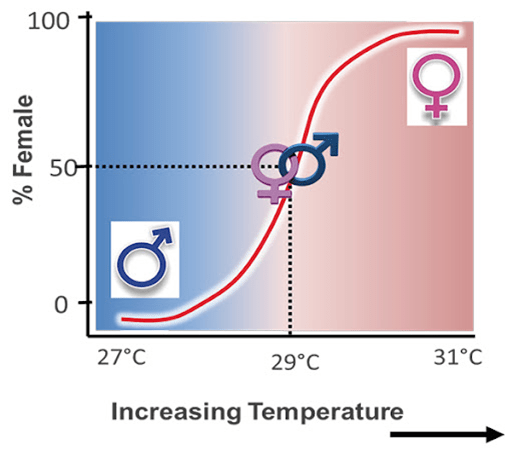
- In some reptiles (e.g. crocodiles and turtles) the temperature of the environment the eggs develop in determines the sex of the offspring. Cooler temperatures cause more males to develop while warmer temperatures lead to more female offspring. Good links here to the impact of climate change on the future of turtle populations as the number of males in some turtle populations has been steadily reducing. This was covered in the recent Planet Earth III series:
- In some fish and invertebrates, their offspring are sexually undifferentiated but if there are more females in their environment they will develop into males. In green spoon worms, this is determined by whether the larvae touch a female’s body whilst descending to the sea floor or not!
https://www.institut-paul-ricard.org/en/especes_aquarium/green-spoonworm/#:~:text=The%20larvae%20are%20planktonic%20and,not%20will%20grow%20as%20females.
The effect of environmental and social factors of sex determination could be linked to the study of epigenetics to explain how they can affect the expression of genes associated with sex determination (A Level only).
- Sexual Dimorphism
Examples of physical and behavioural differences in males and females from different species can be used to help dispel myths about our social construct of there being typical “male” and “female” gender roles.
- Female spotted hyenas have a penis that is only 10% smaller than the males and is used to carry out similar functions.
- All XX (female) Spanish moles have both ovarian and testicular tissue, have a penis-like organ and produce high levels of testosterone which affects their anatomy and behaviour.
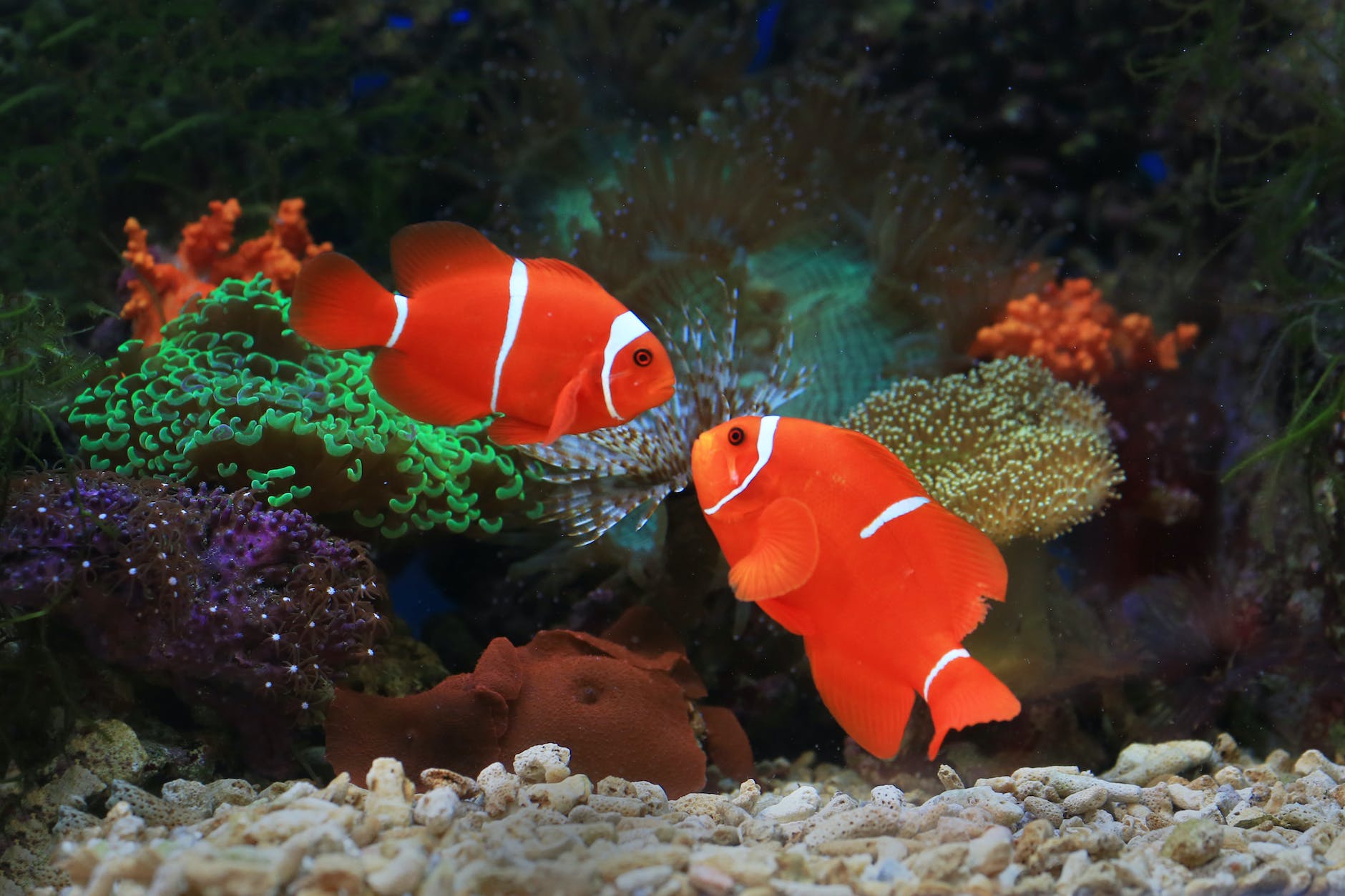
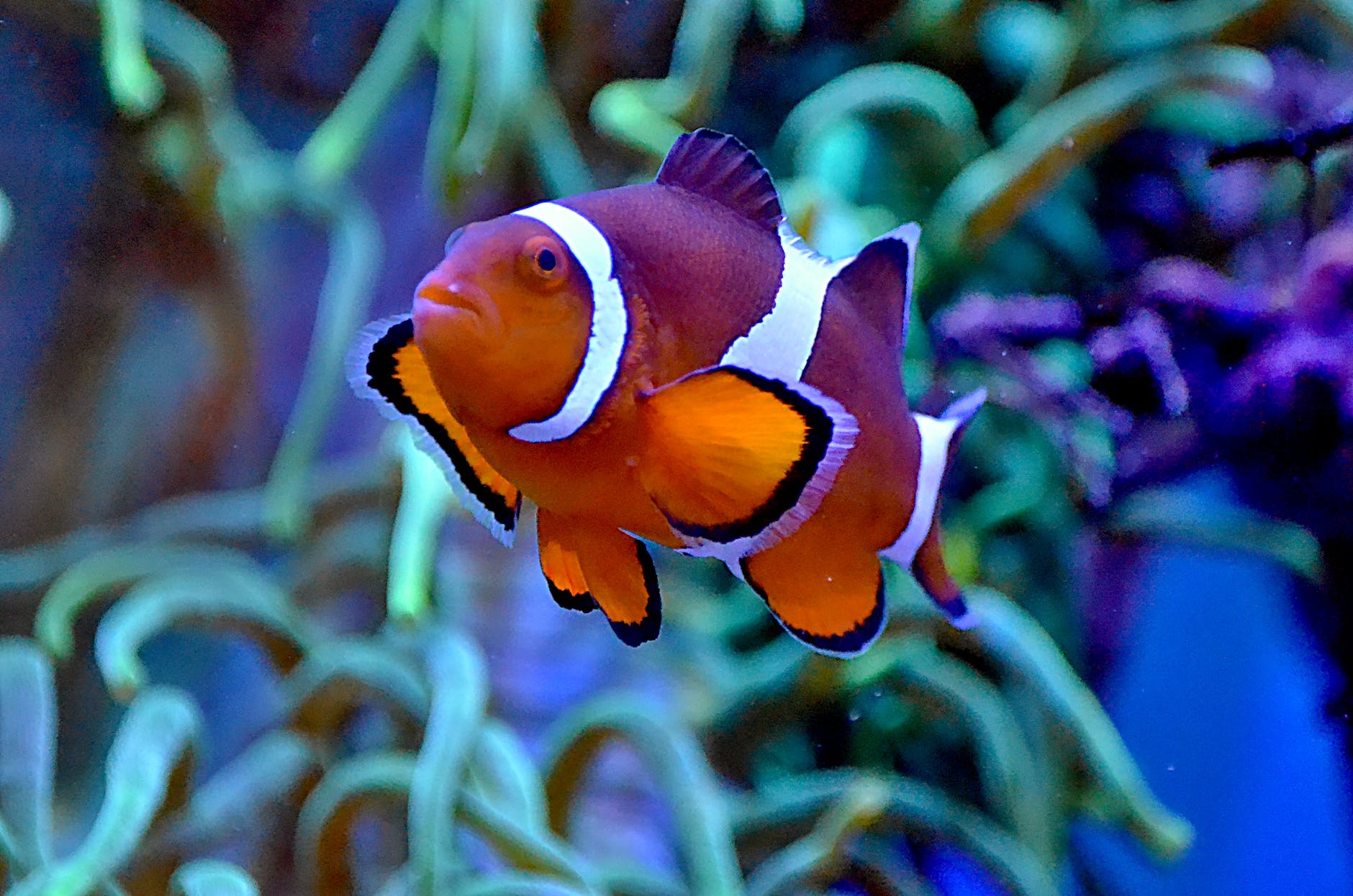
- Many species including most plants, invertebrates, and some fish have the ability to self-fertilise as they produce both male and female gametes or can change their sex over time e.g clownfish which are born male but change into females later in life, or slipper limpets which show alternation of their sex as they pile on top of each other to mate!
- For more examples of sexual dimorphism that subvert the idea of the “dominant male” see this blog by Andrew Thaler https://www.southernfriedscience.com/the-sex-lives-of-spoonworms-10-marine-animals-with-parasitic-dwarf-and-otherwise-reduced-males/
- Same-Sex Couplings
Inevitably when covering these topics questions will arise about different relationships and family units – especially when discussing topics like IVF. There are many examples of same-sex couplings in nature that can be used if these questions do get asked!
Align this with any PSHE teaching going on in school to make sure the message is consistent and obviously consider the age group when discussing sexual attraction/orientation.
Using different examples of families/parents also helps to make sure that students don’t feel “othered”.
- Many birds exhibit pair-bonding behaviour with members of the same sex including courtship behaviour, mating, nest building, and raising foster chicks.
- Similar behaviour has also been seen in beetles, fruit bats, hedgehogs, dolphins, and orangutans.
- Almost all male big horn sheep participate in same-sex courting and mating as males and females only live together during a really short breeding season.
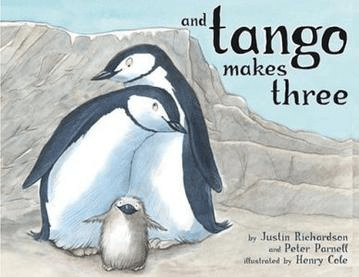
The story of Roy and Silo, a male bonded pair of chinstrap penguins at Central Park Zoo who fostered and raised a chick has been turned into a lovely book that is great for lower key stages!
References
https://education.nationalgeographic.org/resource/how-science-is-helping-us-understand-gender/
https://europepmc.org/article/pmc/4077654
https://education.nationalgeographic.org/resource/how-science-is-helping-us-understand-gender/
https://www.genderinclusivebiology.com/scientific-evidence#theevidence
 Chat Biology