
The structure-function relationship in biology is key regardless of the level of organisation you are dealing with. Think about the arrangement of branches on a classic fir tree at this time of year, how their collective shape helps shed snow, how the needles on each branch align to maximise the light that can be absorbed.
You may have been able to picture the tree in your head, maybe you had one in front of you that you could cast your eyes upon, but what if we started to go a little smaller. Could you picture the cylindrical(-ish) needles and their stomata? Could you visualise the photons striking the photosystems? Do you see how the electron transport chain tidily slots together?
Some of that might have been easy pulling on the classic textbook images or animations you may have used in the classroom, so let’s ramp it up. What about mitochondrial cristae, what keeps those infoldings in that shape, where the membranes are so close together? Can you picture anything?
Hopefully now you are in that curious state of mind, or perhaps questioning how nothing makes sense anymore. Welcome to the world of an A level biologist every time we start chatting about proteins and their roles.
Enzymes always seem to look like Pacman. Fortunately, due to gifs and retro gaming apps, a handful of students may actually know about Pacman. Pacman doesn’t really show selectivity for his substrate through his shape, but we have solved this by making substrates a nice wedge shape. We invest the time when explicitly highlighting the structural differences of maltose, amylose, cellulose, collagen, insulin, etc, but then reduce them all down to a ubiquitous (on an aside, I really like the protein ubiquitin) shapes. It does have it’s advantage in making the concept tangible, but do we lose sight that all the cool stuff in biology is protein dependent? By oversimplifying their diversity do we fail to inspire students to really appreciate them for the miraculous molecules they are and potentially send a few more down a route into scientific research?
I confess, I genuinely get excited about proteins. How there are simply so many of them in us, and so many more in nature despite the small number of genes to play with. It’s amazing that proteins that do the same jobs in different cells can look so different. Have you ever compared RuBisCO from a plant and a eubacterium? So I try to take any opportunity for students to look at the structures we are talking about.
Ruth Brett introduced me to MolAR a few years ago, where students can use their phones to quickly use the Protein Database (PDB) file to visualise the protein, and if they wish, even in an augmented reality form. This acts a gateway to really exploring protein structure with Mol* in subsequent lessons.
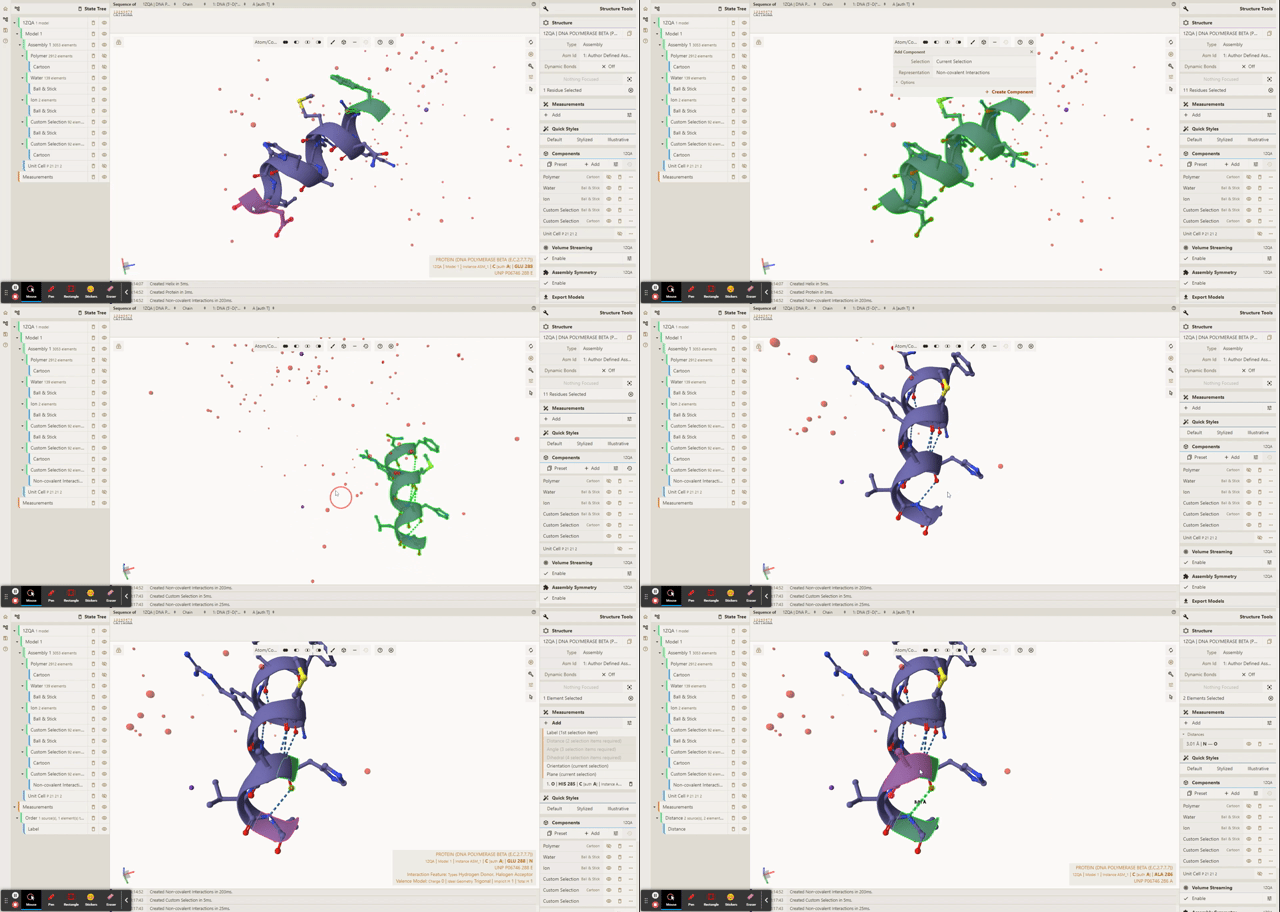
The computational modelling of biological molecules fits in with OCR’s Practical Activity Group 10, so I am more than happy to treat it as a “practical with benefits.” By making the students develop competency with Mol*, they practise their recall and recognition of bonds, levels of protein structure (including the subunits), active sites, co-enzymes, co-factors and prosthetic groups. It seems to be helping them apply their knowledge to novel scenarios in OCR’s exam papers. I am really glad that Mol* was shared at the online ASE Conference back in 2021, it feels like I’ve been using it for a while, but it has allowed me to refine how I use it. Rather than trying to “tick the boxes” for PAG10, the focus is on a small number of operational skills (supported by walkthrough videos) such as measuring hydrogen bonds within an alpha helix, and more on structure function relationship. Mol* also allows multiple models to be viewed on the same canvas, great for comparing different proteins. And now, you can even load up AlphaFold models for things like elastin that still have yet to be experimentally resolved (wet lab).

Above is a quick demo of changing how histone subunits can be visualised. This is one of those examples where all of the subunits are important and how they interact with DNA is key. However, if you just wanted to recap some protein structure, students can slim down what they are looking at.
Below is DNA polymerase, in a ribbon (this is a great Women in STEM story) representation which would allow the recall of secondary structures, differences between polynucleotides and polypeptides…
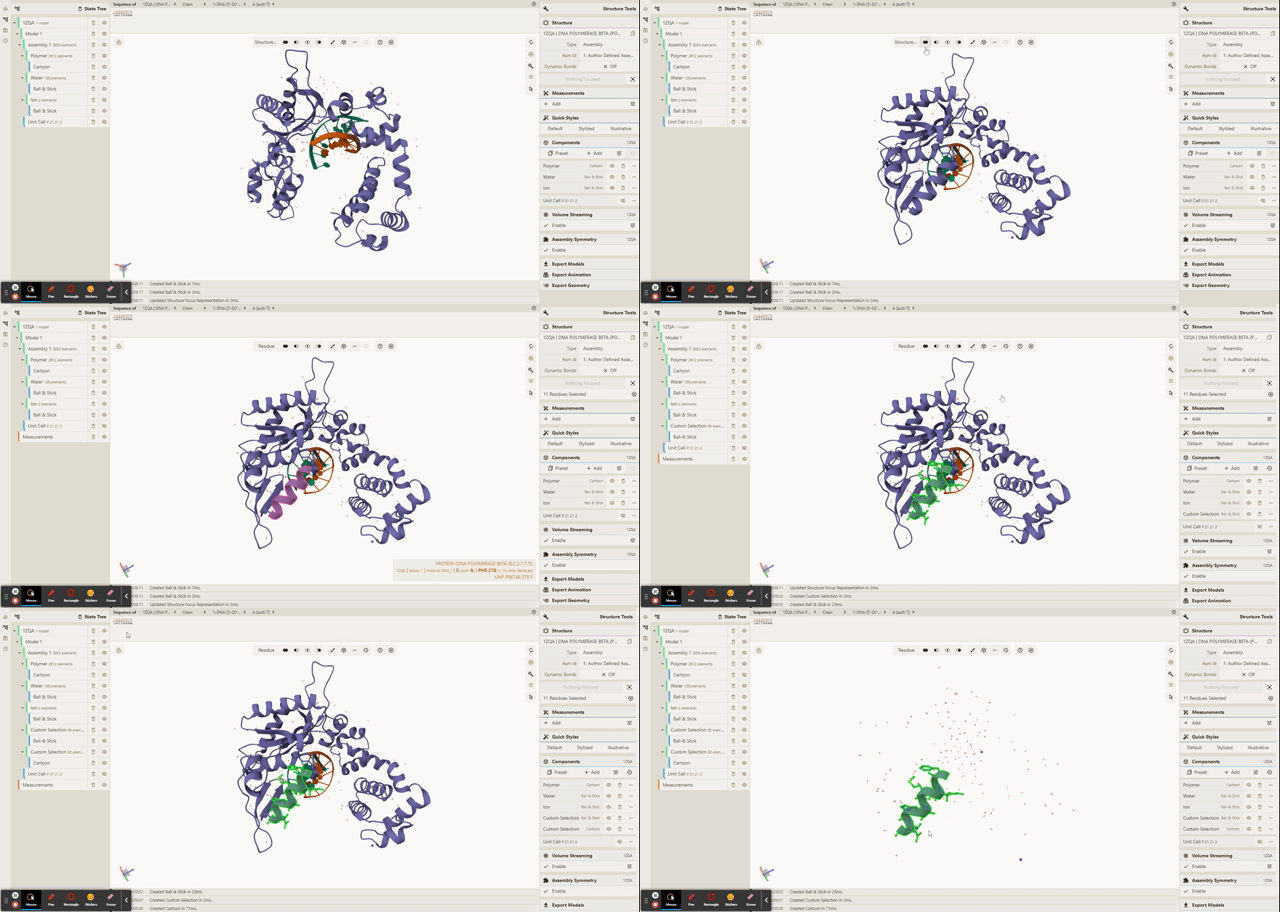
Next, you can make your selection and hide the rest with the left-hand state tree “eyes”. Now rather than looking at every hydrogen bond within the enzyme and double-stranded DNA molecule, students can look and measure, for example, the hydrogen bonds within an alpha helix.
The fact that Mol* is webbased, and can even be used with an iPad makes it a phenomenal tool for the classroom, especially where you have a Bring Your Own Device policy.
The last thing I will leave you with is the next level in Mol* development, the modelling of cells and parts thereof. Below is a model of a synapse. Just look at the size of the vesicle compared to the cleft. You can hide as many components as you like, or build it up. The complexity is amazing and there are more examples to have a look at.
In short Mol* is awesome. https://molstar.org/viewer/
If you would like a list of molecules that you could use for a particular topic, do @BeaulieuBio me. I have compiled quite the list of pdb filenames.
 Chat Biology
Proteins are such a complex topic in biology, but so vital! They are one of the few topics that are discussed throughout the entire year! I teach them with macromolecules, cell structure and function, genetics, and protein synthesis just to name a few topics. MolAR is definitely a beneficial way for students to interact with the model and understand the true structure of proteins and how that relates to their functions.
LikeLike