
Over the years I have found that students often say this cycle is difficult, but I couldn’t fathom why. One particular year I had to try to find a better way to teach it and this is now our department default method. We’ve tweaked it so that it also helps to reinforce some active revision. As we usually deliver it near the start of the autumn term of second year it supports students who still need convincing to move away from reading and highlighting as their default (and only) revision technique.
We start as many teachers do, with some simple questions that can be answered using MWB in pairs and helps students think about why we are learning this cycle in particular:
- What molecules have you learned about that contain nitrogen?
I usually tie this in with phosphorous rich molecules as well so they can see there is massive overlap of molecules on the two lists.
- Why do you think AQA have put this cycle (and phosphorous) on the course?
We need students to realise the importance of these nitrogen-rich (or phosphate rich) compounds and the role that plants play in their uptake at the start of food chains/webs.
- Where is there a lot of nitrogen, and can plants use it?
Understanding that atmospheric N2 is inaccessible to plants directly, but that most organisms are relying on plants to take up nitrogen in some format and build these nitrogenous compounds means students see the issue we need to deal with. Virtually the whole cycle is about getting nitrogen into a form that plants can access.
Once the context is set, we move quickly through the three processes that allow plants to gain nitrates and we keep them as separate processes to begin with. AQA is not as heavy on the detail of the bacteria carrying out each stage so this doesn’t take long. Make sure that non-chemists know they are probably safer writing out names of compounds in full than risking getting the charges wrong in the exam. For this reason we stick to words rather than formulae when teaching this but the chemists know they can use whichever they know they can do quickly and accurately in the exam.
We capture this learning as we go through each stage by students recording in their notes with a side heading for each of the three processes, noting the name of the stage and the organisms responsible.
Then I ask a question which I think helps their understanding long term.
How many ways are there for ammonia to be formed in the Nitrogen cycle?


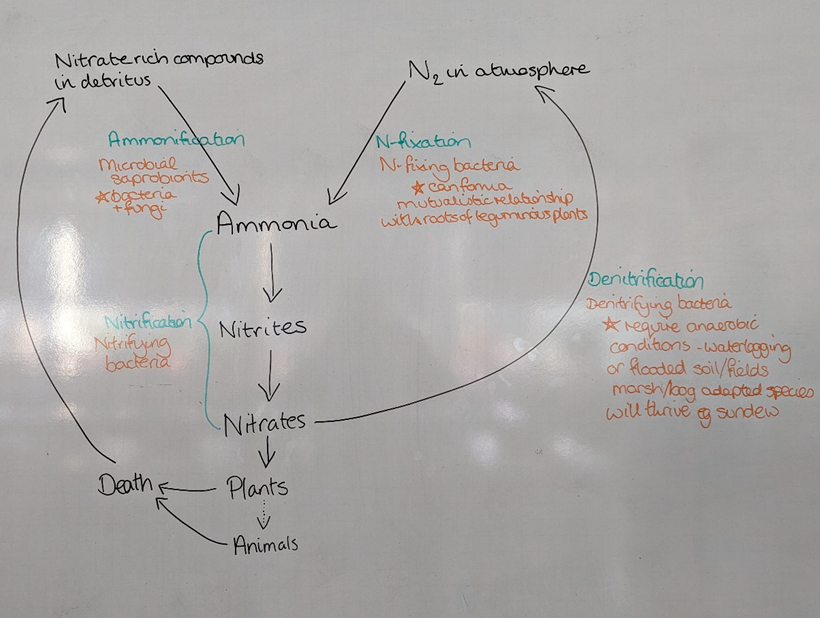
I’ve found that turning the cycle into a diagram that is primarily a flow chart is really helpful to student understanding and recall. We build it up on the board with students following on MWB.
At this stage only denitrification is missing.
We then add in the names of the stages and the names of the microorganism group responsible. Currently AQA is using microbial saprobionts as the term for organisms that carry out ammonification but it’s always worth mentioning that past papers through the years have accepted/used microbial saprotrophs and microbial saprophytes on other specifications.
Then by spotting the diagram so far allows for a cycle when organisms die back up to detritus but there is no cycle to N2. At this point we add denitrification to their notes and finish the diagram.
The version below is missing the nitrous oxides which we have discussed in class but the aim of the diagram is to keep it simple for revision and ensure all students can maximise marks.
The extra bits with a * are to help students remember key facts about these microorganisms and we approach it as an “odd one out”.
Eg. Why are Nitrogen fixing bacteria the odd ones out? Because they are the only group that can form mutualistic relationships with roots of leguminous plants as well as existing free-living in the soil.
When we teach this we are aiming to embed the basics. Later in the term when we are doing essay questions on the importance of cycles, we take this topic further and make links to the farming practices which are embedded in these basics. This gives students an opportunity to recall the cycle and the key facts for each stage, then take it on further to make links, showing the “importance” which is necessary for higher essay scores.
As AQA uses SOLO taxonomy to mark the essay, we try to embed this through the revision activity.
All of this has taken a lesson and a half by this point. We might save the revision task for another day and do some exam questions for remainder of the second lesson.
Showing how active revision of the nitrogen cycle might work…
Each student gets a small pile of post-it notes. We usually break up some packs and leave enough on each row for students to get what they need. The instructions for the class are as follows:
- Take four post-it notes and on each one write the name of one stage of the cycle. Check that they all have ammonification, N-fixation, nitrification and denitrification.
- Take another four post-it notes and write the name of the microorganisms that carry out each of the four stages. Check they have microbial saprobionts, N-fixing bacteria, nitrifying bacteria and denitrifying bacteria. If you teach a different exam board, this is where you’d need to include the relevant species names.
- Take five post-it notes and write the names of the molecules at each part of the diagram. You may want them to draw the diagram out at the same time, it’s often easier to. Our students love writing on the tables and the lab worktops wipe clean so we let them draw really big diagrams rather than try to do it on the MWB which isn’t large enough.
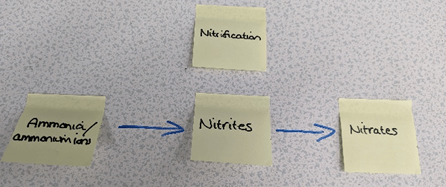

You can ask them to do anything with these post-its, from pairing up the stages with their microorganisms (easy checkpoint after instruction 2 above), to stage specifics as shown below, or whole cycle diagrams, again shown below.
This links with SOLO taxonomy, as knowing the key terms is multistructural, linking is relational etc.
We get students to keep their post-it notes, having shown them how easy it is to use these 13 keywords/phrases as a key part of their revision. They keep them in a plastic wallet and we encourage students to use them regularly to check they can still construct and relate the microorganisms to the stages.
Many of our cohort of 200 Biology students have said they enjoy learning the cycle this way and know it well. They also find it easy to reproduce it on a MWB prior to completing exam.
 Chat Biology